Friday, August 5, 2011

2011 ADGA Nationals

Reynolds Acres had a great time at the 2011 ADGA Nationals! Thanks to all of the sponsors for supporting this great event!

Reynolds Acres Magnolia got 1st place Intermediate Kid!!!
I (LeeAnn Reynolds) won the Nigerian Dwarf Youth Premier Breeder award!!!
Reynolds Acres got 3rd place Dam and Daughter
Reynolds Acres Joy got 4th place Yearling Milker
Reynolds Acres got 4th place Produce Of Dam
Reynolds Acres got 5th place Nigerian Dwarf Dairy Herd
Reynolds Acres got 5th place Best 3 Senior Does
AGS Doubletree Maggie's Annamarie got 6th place 4 year old Milker
Sparkling Star's Bambi got 6th place 4 year old Milker (Recorded Grade)
AGS Doubletree Puck's Maggie got 6th place 7 years and older Milker
AGS Doubletree Maggie's Maryann got 7th place 4 year old Milker
Reynolds Acres Rosie got 8th place 2 year old Milker
Reynolds Acres Robyn got 11th place 2 year old Milker

Here are a few pictures of Reynolds Acres at ADGA Nationals:


Tuesday, June 7, 2011

Nigerian Dwarf Bucks


This year, Reynolds Acres got two bucks from some of the best known lines in Nigerian Dwarfs - Rosasharn and Doubletree. These sweet little boys have great genetics, and I am excited to see how they and their offspring do.

If you are interested in breeding to one of these bucks, please contact me at reynoldsgoats@yahoo.com

All the goats from the herd must test negative for CAE, CL and Johnes. Also, please make sure goats are healthy and free of lice, warts, ringworm, soremouth, and other contagious diseases, or else they will not be allowed to go in with the bucks. Before does go in with the bucks, they will be checked for health problems.

Rosasharn AX Nickerbean *B
Sire: Rosasharn AL's Astrix
Dam: AGS Rosasharn's TL Mariposa 3*M
Date Of Birth: 03/18/2011
"Nick" is a sweetheart of a buck. He will follow me anywhere. He has a smooth, level topline, is wide in the chest, and has very desirable head characteristics. His ears are crooked because of an infection he got from his tattoos, but it's not genentic, and if anything it makes him cuter! He is tan and heavily spotted with gray moonspots. I am looking forward to seeing how he and his offspring perform in the show ring.
To view further info on Nick's pedigree, go here:
Http://adgagenetics.org/GoatDetail.aspx?RegNumber=D001561387
(Goats not registered with ADGA will not be shown)
Stud Fee: $100
Stud Fee with Reynolds Acres Discount (only for goats with Reynolds Acres herd name): $90
Stud Fee with 4H Discount (only for 4Hers and Cloverbuds - one goat per 4Her per year): $75


AGS Doubletree Perfect Storm
Sire: AGS Doubletree Teddi-Bear
Dam: AGS Doubletree Blu Tahoe
Date Of Birth: 05/10/2011
"Storm" is a goat who certainly lives up to his name. He is mostly black with some white markings and blue eyes - a very striking buck. I am excited to see how he and his offspring do in the show ring and milk pail.
Stud Fee: $75
Stud Fee with Reynolds Acres Discount (only for goats with Reynolds Acres herd name): $65
Stud Fee with 4H Discount (only for 4Hers and Cloverbuds - one goat per 4Her per year): $50

Storm's Pedigree:

Thursday, December 23, 2010

Oberhasli Doe

Oberhasli Goat Heritage


O-mazing Oberhaslis


Our Oberhasli breeding program favors the outstanding genetics of DEVONSHIRE, TONKA-TAILS, STORM HAVEN, SUN-KISSED, and OWL-RIDGE. They have won Best of Show and Best of Breed at the Dutchess County Fair, New York.


Above left: Reynolds Acre's Kaylea and Reynolds Acre's Sophie Above right: Sparkling Star's Bambi

The Doe:

Sparkling Star's Bambi
Sire: Devonshire MF Finite Moment *B
Dam: The Storm Haven's Mudpie
Has had: 2 set of twins
1 single
To see more of Bambi's pedigree, go here (goats not registered with ADGA will not be shown):
http://www.adgagenetics.org/GoatDetail.aspx?RegNumber=E001413870

Bambi is currently our only Oberhasli doe. She is a recorded grade (75% oberhasli, 19% alpine, and 6% toggenburg) but if bred to an Oberhasli Buck, her kids are oberhasli (as long as they have Oberhasli markings). She has a beautiful udder. Both her grandfathers (Devonshire FH Fiasco and Tonka-Tails Nestor of Jest) are *B, and her one grandmother (Devonshire RK Minuette) is a 3*M and her other grandmother (Sun-Kissed Miss Cheyenne) is a 1*M. At the 2010 Two-Ring Progressive Dairy Goat Show in New York, Bambi got Best of Breed for Recorded Grades in one ring and Reserve Champion in the other. Her half sisters, who were full Oberhaslis, each got a Best of Breed in a ring. She is just one Unrestricted leg away from becoming and ADGA permanent champion!

Nigerian Dwarf Does

Nigeran Dwarf Goat Heritage


Not small...
Fun sized!!


Our Nigerian Dwarfs come from nationally famous breeding stock HAYSEED FARMS, TALONS, GAY-MOR, TWIN CREEKS, 4-FUN, KAAPIO ACRES, and STONEWALL. Some of our newer Nigerians also come from Chenango-Hills, Rosasharn, and Good Wood. The Reynolds’ Acres Ranch herd has a unique and distinctive style; looking and milking just like the standard dairy goat, in miniture!

Above left: AGS Doubletree Maggie's Annamarie Above right: AGS Doubletree Puck's Maggie

The does:

AGS Doubletree Maggie's Annamarie 1*M
Sire: AGS 4 Fun Frankie Sinnot
Sire's Sire: AGS Kaapio Acre's RA Whiskey Blues
Sire's Dam: AGS Stonewall's Hetta Carbury
Dam: AGS Doubletree Puck's Maggie
Dam's Sire: AGS Doubletree C Puckadoodle
Dam's Dam: AGS Gay-Mor's Madey's Zip Novella
Has had: 3 sets of triplets
DOB: 06/18/2007
"Anna" is a tri-color brown doe with black and white markings. She has a level back-line and a nice attached udder. She has gotten 1 Junior Champion, 3 Best of Breeds, 3 Grand Champions, one Nigerian Dwarf Best Udder, and 1 Reserve Champion. She has one the Dutchess County Fair 4H Highest Butterfat award for the past two years in a row (this year, her butterfat percentage was 8.4%). Her daughters have been junior champions and reserve junior champions, and we are looking forward to seeing their udders next spring. Anna is a sweetheart, and loves nothing more than to curl up on someone's lap.

AGS Doubletree Maggie's Maryann
Sire: AGS 4 Fun Frankie Sinnot
Sire's Sire: AGS Kaapio Acre's RA Whiskey Blues
Sire's Dam: AGS Stonewall's Hetta Carbury
Dam: AGS Doubletree Puck's Maggie
Dam's Sire: AGS Doubletree C Puckadoodle
Dam's Dam: AGS Gay-Mor's Madey's Zip Novella
Has had: 1 set of twins
1 single
1 set of quads
DOB: 06/18/2007
"Mary" is a black doe with white markings. She has a well attached udder, and is a great milking goat. She has gotten 1 Reserve Junior Champion, 1 Grand Champion, 1 Best of Breed, and 3 Reserve Champions. She is very friendly and patient.

AGS Doubletree Puck's Maggie
Sire: AGS Doubletree C Puckadoodle
Sire's Sire: AGS Hayseed Farm's LD Chaos
Sire's Dam: AGS Talon's Montego Bay
Dam: AGS Gay-Mor's Madey's Zip Novella
Dam's Sire: AGS Gay-Mor's LR Made To Order
Dam's Dam: AGS Twin Creeks Zippity Do Da
Has had: at least 1 set of twins
at least 1 single
DOB: 04/15/2002
Maggie is a tri-color white doe with black and brown markings. She has a great top line and overall Nigerian characteristics. She is a heavy milker, and our oldest Nigerian doe. Maggie is a matriarch, and when we do not breed her, she takes good care of her grandchildren.

Reynolds Acres Rosie
Sire: Chenango-Hills Bilbao Baggins *B
Sire's Sire: Chenango-Hills UR Ring Bearer *B
Sire's Dam: Chenango-Hills I P Goddess 2*M
Dam: AGS Doubletree Maggie's Annamarie 1*M
Dam's Sire: AGS 4 Fun Frankie Sinnot
Dam's Dam: AGS Doubletree Puck's Maggie
Has had: 1 set of twins
DOB: 04/12/2009
To See More of Rosie's Pedigree, go here (goats not registered with ADGA will not be shown):
http://www.adgagenetics.org/GoatDetail.aspx?RegNumber=D001491524
Rosie is a tan junior doe with white markings. She and her sister were born late Easter night, and certainly are the best Easter presents I could ever get! She has gotten 2 junior champions and 1 reserve junior champion. She has the best udder in the herd, and a great topline. Her paternal grandmother, Chenango-Hills I P Goddess, was the 2010 ADGA DHIA Breed leader in all three categories (butterfat, milk production, and protein), and Goddess has been awarded several best udders and best of breeds.

Reynolds Acres Robyn
Sire: Chenango-Hills Bilbao Baggins *B
Sire's Sire: Chenango-Hills UR Ring Bearer *B
Sire's Dam: Chenango-Hills I P Goddess 2*M
Dam: AGS Doubletree Maggie's Annamarie 1*M
Dam's Sire: AGS 4 Fun Frankie Sinnot
Dam's Dam: AGS Doubletree Puck's Maggie
Has had: 1 set of twins
DOB: 04/12/2009
To See More of Robyn's Pedigree, go here (goats not registered with ADGA will not be shown):
http://www.adgagenetics.org/GoatDetail.aspx?RegNumber=D001491523
Robyn is a very sweet brown junior doe with white, tan, and black markings. She has gotten 2 reserve Junior Champions. Information about her paternal grandmother is found above. She and Rosie are sisters and best friends. They are some of the friendliest goats you'll ever meet, and, just like the princesses they are, love to have their legs and hooves rubbed!

Reynolds Acres Joy
Sire: Chenango-Hills RB Legacy *B
Sire's Sire: Chenango Hills UR Ring Bearer *B
Sire's Dam: Chenango Hills Gabriella 5*M
Dam: AGS Doubletree Puck's Maggie
Dam's Sire: AGS Doubletree C Puckadoodle
Dam's Dam: AGS Gay-Mor's Madey's Zip Novella
Has had: 1 set of twins
DOB: 05/14/2010
To See More of Joy's Pedigree, go here (goats not registered with ADGA will not be shown):
http://www.adgagenetics.org/GoatDetail.aspx?RegNumber=D001521625
Joy is a brown, black and white junior doe, with an attitude! She has a great top line and great Nigerian characteristics. She has gotten 1 reserve junior champion. This little girl is sure to be a good milker and show goat when she grows up. Her udder is so soft and she's a pleasure to milk, just like her mother. She's very spunky (she fights with all the goats, no matter how much bigger they are), but is very nice to humans.

Sunday, November 28, 2010

Reynolds Acres Ranch News!

We've had a very successful year. My Recorded Grade, Sparkling Star's Bambi, is only one show leg away from being a permanent champion! My Nigerian Dwarf, AGS Doubletree Maggie's Annamarie, got a milk star and is now a one star milker!

We're breeding three goats this year that were born on Reynolds Acres Ranch and are looking forward to the very first Reynolds Acres Ranch second generation next spring!

Happy Goating!

Monday, July 26, 2010

Finding Homes

I learned a lot this year about finding goats homes. For my Nigerians, it's pretty easy. A lot of people love Nigerians, and want them as pets. But I also had a Recorded Grade Wether, who is a lot harder to find a home for.

For those people who want to find great homes for their goats, there are three different ways of going about it.

1. The Positive Way - This means putting the goat you want to sell out there. Basically putting up advertisements. Some great places to put up ads are veterinary offices, feed/grain stores, and websites, such as your farm website or Craigslist. Also, put up ads at goat shows; people at goat shows usually have goats or are interested at getting goats.
2. The Negative Way - This means looking for people who want goats. Look for want ads in the newspaper, or at animal stores. Look at online sites, such as Craigslist.
3. The Neutral Way - This means waiting for people to ask you or contact you about goats. Often, people who say that it is hard or impossible to find wethers homes only practice the neutral way, and while it does work sometimes, you can't rely on it to find all your kids homes.

To find the best homes possible, you are going to want to use all three ways. Put up advertisements, look for want ads, and see if anybody contacts you.

Remember, if you want to find your goat a good home, put advertisements in places where you think you'd find one. The vet's office is great, because people who have animals and livestock go to the vet's. Avoid putting ads in places like Supermarkets or delis, since this could attract unwanted attention from people who want to buy a goat for meat.

If someone contacts you about getting a goat, don't just sell them whatever you have. Talk to them about what they want and what they need. Someone who wants to start a dairy farm should get does. Someone who wants to show should get good show goats. Someone who just wants pets could have wethers, or those goats who are wonderful but don't have good show qualities.

Never think, "I'm never going to find this goat a good home. I should just give up." Of all the people in the world who want goats, there has to be a few people who are looking for a goat exactly like the one you're selling. It might take some time to find that person, but if you really want to get that goat a good home, you're going to find them.

I hope this helps you find good homes for those wonderful goats. And, thankfully, it helped me find a great home for that Recorded Grade wether.

Sunday, May 2, 2010

For Sale

All the kids at Reynolds Acres Ranch have found great homes! If you are still interested in getting a goat, you can reserve a Reynolds Acres Ranch kid now, or you could ask me about other people who have goats.

If you need to contact me, e-mail reynoldsgoats@yahoo.com

While you're here, check out all the other fun stuff Reynolds Acres Ranch has to offer!

Thursday, October 22, 2009

Reserve your kids now!

Hey everyone! This year at Reynolds Acres Ranch, we're breeding 3 Nigerians and 1 Recorded Grade (her kids should be American Oberhasli). Be sure to get on our list! We already have two people waiting for Nigerians.

Goats are great, and Reynolds Acres Ranch goats make great:

Milkers. One of our Nigerians got the highest butterfat award (with a 7.26%) this year. Their milk is very sweet and makes great fudge and pudding. Our Nigerians give a little over a pound of milk each, and our Oberhaslis give between 2-3 pounds.

Show Goats. My Oberhasli doe, Bambi, got Junior Champion her first year at the fair. My Nigerians have gotten Best of Breed, Senior Champion, and Junior Champion at the fair for 2 years in a row. And our younger Nigerians have lines from Rosasharn and Chenango-hills.

Pets. Our goats are very friendly, even though they are not bottle raised. We spend lots of time with them, and every goat is special. In fact, our goats are so friendly that my 2 year old Nigerian Dwarf still sits on my lap like she did when she was a baby, and my oberhasli gives me kisses. The Nigerians tend to be more cuddly than the Oberhaslis, but they both are great.

Plus we make sure each goat is has healthy as possible when we sell them. Everyone we've sold too is very happy with their goats.
To reserve your kid(s), e-mail me (LeeAnn Reynolds) at reynoldsgoats@yahoo.com. Wouldn't you like to add a Reynolds Acres Ranch kid to your herd?

Prices vary with goat, depending on gender, breed, and stature.

To view more info about our does, go to

http://reynoldsacresranch.blogspot.com/2008/12/nigeran-dwarf-goat-heritage.html

for Nigerian Dwarf Does or to

http://reynoldsacresranch.blogspot.com/2008/12/oberhasli-goat-heritage.html

for Oberhasli Does.

The Reynolds' Kids


These are our "children," Reynolds Acre's Rosie (left) and Reynolds Acre's Robyn (right). This was our first year with kids, and we had 6 in total (four Nigerian Dwarfs, one Recorded Grade, and one Oberhasli). All of them got good homes, and we're keeping this adorable pair. Rosie got Reserve Nigerian Dwarf Junior Champion in the Open Show at the Dutchess County fair (NY) and Nigerian Dwarf Junior Champion at the 4H show.

Their mother, AGS Doubletree Maggie's Annamarie, took Nigerian Dwarf Champion for the second year in a row.

Having goats is so much fun! So far, we're enjoying this year and looking forward to next year.
Below: Robyn and Grandma, AGS Doubletree Puck's Maggie Below: Rosie

Friday, December 12, 2008

Our Favorite Recipes

These are goat milk recipes that we highly recommend, since they are delicious, and they help spread the joy of goat milk products:

Chocolate Goat Milk Fudge
  • 2 1-oz squares unsweetened chocolate (You may substitute 1/3 cup cocoa and 3 Tbsp butter for unsweetened chocolate)
  • 3/4 cup fresh goat milk
  • 2 cups sugar
  • 1 tsp light corn syrup
  • 2 Tbsp butter
  • 1 tsp vanilla
Melt chocolate in milk. Add sugar and corn syrup; cook slowly, stirring constantly until sugar dissolves. Cook gently to softball stage (234 degrees Fahrenheit), stirring frequently. Remove from heat; add butter and cool at room temperature until lukewarm (110 degrees Fahrenheit) without stirring. Add vanilla; beat vigorously until fudge becomes thick and loses its gloss. Quickly spread in buttered pan. When firm, cut into squares. Makes about 2 dozen.

This recipe is so good, my mom was hesitant about drying off the goats for the winter, since she didn't want to wait until spring for goats milk again. Must freeze milk so we can make this in winter.

Chocolate Pudding
  • 3 cups fresh goats' milk
  • 1/3 cup cocoa
  • 1/3 cup sugar
  • 1/4 cup cornstarch (can substitute with 4 tablespoons flour)
  • 2 tsp butter or margarine
  • 2 tsp vanilla
In a heavy medium saucepan stir together the flour, sugar, and cocoa powder. Stir in milk. Cook and stir over medium heat until mixture is thick and bubbly. Cook and stir for another minute. Remove from heat; add butter and vanilla.

Goat Milk Recipes

Visit Reynolds' Acres Ranch Website!

Goat's Milk Pie Crust

* 4 cups unsifted flour (we used whole wheat, but any flour will do)
* 1 Tablespoon Honey
* 2 teaspoons salt
* 1 3/4 cups shortening
* 1 Tablespoon white or cider vinegar
* 1 large egg
* 1/2 cup goat milk
Mix the flour and salt together in a large bowl. Add shortening and cut in until ingredients are crumbly. In a small bowl, beat together milk, vinegar, honey, and egg. Combine the two mixtures and stir with a fork until all ingredients are moistened. This recipe makes 5 pie crusts. It can be kept chilled in the refrigerator for up to a week. If you freeze the dough, you can still thaw it and roll it out. Also, you can roll it out, place in pie pans, put in zip-lock bags and freeze it that way too. It's an easy recipe to make, easy to roll out, easy to work with. The dough will stay flaky no matter how much you handle it. It will shrink a bit in the pie pan so let it rest for about 5 minutes after you get the crust in the pan before you trim it and flute it. We used it over Thanksgiving for apple pies, gooseberry pie, and pumpkin pie; and it didn't get soggy in any of them.

Goat's Milk Pumpkin Pie

Ingredients:
* 3 beaten eggs
* 1/2 cup white sugar
* 1/2 cup brown sugar
* 1 tablespoon cornstarch
* 1/2 teaspoon salt
* 1 teaspoon cinnamon
* 3/4 teaspoon pumpkin pie spice or ginger and nutmeg.
* 1 1/2 cup pumpkin. One regular sized can of pumpkin works, NOT the big can.
* 1 cup goat milk

Mix the sugars into the beaten eggs. Add cornstarch, salt, cinnamon, and spices. Mix well. Stir in pumpkin and goat milk. Mix well. Pour into unbaked pie shell. 8-10 inch works best. This will make 2 pies in regular shells, do not use deep dish shells. Bake at 425 degrees for 15 minutes, then reduce heat to 350 degrees and bake for another 40 minutes. This is a great recipe, and nobody at my house could tell the difference on Thanksgiving day.

Goat's Milk Fudge

A fun and easy recipe:
* 3 cups sugar
* 2/3 cup goat's milk
* 3/4 cup margarine
* 6 ounces chocolate chips
* 7 ounces marshmallow cream
* 1 teaspoon vanilla

Combine sugar, milk, and margarine in heavy quart sauce pain. Stirring constantly, bring to full rolling boil. Reduce heat to medium, and continue boiling for 5 minutes. Remove from heat, and stir in chocolate chips until melted. Add marshmallow cream and vanilla, beating until well blended. Pour into greased 9 x 13 pan. Cool at room temperature. You can add nuts if you wish also. The chocolate chips can be substituted with butterscotch chips, almond bark, etc., if you want to try out different flavors of fudge too. This one is so easy, the kids can do it!

Yogurt

Making yogurt is a fairly simple process. It requires a thermophilic culture or one made of a starter yogurt. You can either use a heaping tablespoon of cultured yogurt for this or make and freeze your own culture, or just save a cup of plain yogurt to start the next batch with each time.
Ingredients1 quart whole milk, heated to 100 degrees.1/3 cup instant nonfat dry milk (this is an optional ingredient. It produces a thicker texture and increases the protein content by 2 grams per cup.)1 rounded tablespoon plain yogurt or recommended quantity of powdered culture or 1 ounce of thermophilic starter.Mix ingredients, follow instructions for yogurt maker. or, if you don't have a yogurt machine:With a thermosAlmost fill a thermos bottle (preferably wide-mouthed) with milk heated to 100 degrees F. Add 2 tablespoons of plain yogurt and mix thoroughly. Put the lid on and wrap the thermos in two or three terry towels. Set it in a warm, draft-free place overnight. In an ovenPour 1 quart of milk into a casserole dish and add 3 tablespoons of plain yogurt. Stir well and cover the casserole. Place in a warm (100 degree F.) oven with the heat off. Let it sit overnight. On a heating padMix 1 quart of milk and 3 tablespoons of plain yogurt. Set an electric heating pad at medium temperature and place in the bottom of a cardboard box with a lid. (A large shoe-box works well.) Fill small plastic containers with the milk-yogurt mixture; put on the lids. Wrap a heating pad around the containers, then cover with towels to fill the box and let sit, undisturbed, for 5 to 6 hours. In the sunPour 1 quart warmed milk into a glass-lidded bowl or casserole. Add 3 tablespoons plain yogurt and cover with the glass lid or a clear glass pie pan. Place in the sun on a warm (not too hot) summer day and let sit 4 to 5 hours. Watch it to make sure it is not shaded as the sun moves. On the back of a wood-stoveMany grandmothers made clabber by setting a bowl of freshly drawn milk on the back of the stove after supper. Make yogurt this way by adding 1 cup starter to 2 quarts milk and let it sit, loosely covered with a dish towel, on the back of the cooling wood range overnight. In a Crock-PotPreheat a Crock-Pot on low for about 15 minutes, until it feels very warm to the fingertips. Put covered containers of yogurt mixture into the Crock-Pot, cover it, and turn off the heat. At 35- to 45-minutes intervals, heat the Crock-Pot on low for 10 to 15 minutes.

For flavored yogurt:

Instructions:

Scald 1 quart of milk (or heat to 188 degrees) and stir in 1/4 to 1/3 cup sugar, honey, maple syrup, chocolate syrup, malt, molasses, or artificial sweetener. If other flavors are desired, after dissolving the sugar or honey, stir in 1 tablespoon of extract, such as vanilla, lemon, almond, or peppermint, or instant coffee. Another time, try adding 1 teaspoon of ground spices, such as cinnamon, nutmeg, mace, ginger, or your own special combination. Add the instant nonfat dry milk, cool the mixture to 110 degrees F, and stir in the culture. Pour into warm containers, cover, and incubate. For jam, preserve and peanut butter flavors, put 1 tablespoon of the flavoring into the bottom of 1-cup containers and pour the warm milk-yogurt mixture over. Cover and incubate as usual. If fresh, canned, or dried fruit is desired, it is best to make such additions to the yogurt after it has incubated. The acid content of some fruits can curdle the milk-yogurt mixture and prevent proper fermentation. Whenever you are flavoring yogurt, always remember to leave 1 cup plain, so that you will have fresh starter for the next batch.

Quick and Easy Mozzarella Cheese

This recipe is a quick, simple, easy recipe to make a 2-lb block of mozzarella cheese:

Ingredients:

1. 2 gallons of cool milk, either fresh & raw or pasteurized and cooled.
2. Citric acid powder. 2 1/2 very level teaspoons of citric acid powder dissolved in 1/4 cup of cool tap water. Mix into the cool milk for 2 minutes.
3. Heat milk to 88 degrees F. This is not an error. You are not trying to pasteurize the milk. If you get it too hot or too cold, the rennet will not take make curds.
4. Rennet: 1/2 teaspoon liquid rennet (or 1/2 tablet regular rennet OR 2 junket tablets). Dissolve rennet in 1/4 cup cool tap water. Add this into the milk and stir for 14-20 seconds. Cover your pot with a lid and allow milk to remain still for 12-15 minutes while it coagulates.
5. Cut the curd into cubes, around 1/2 inch in size. Let cut curds remain undisturbed for 5 minutes. Apply low heat and stir gently so as to keep curds separated. The curds will shrink as the whey is expelled from them in this step. Slowly heat the curds to 108 degrees over about 10-15 minutes time. Then shut off the heat and continue to stir every few minutes for an additional 20 minutes.
6. Drain curds in a colander for about 15 minutes. You can dip or pour them out of the pan and save the whey to make ricotta if you wish, or save it for the pigs or chickens, or throw it out. After the curds sit for 15 minutes, they will be stuck together in a colander shaped clump. Cut this into strips about 1 inch by 1 inch cross section. Lay the strips in a criss-cross fashion in a large bowl.
7. Mix 1/4 cup salt in 1/2 gallon of water and heat to 170 degrees. I always heat this water up while I am stirring the curds for that 15 minutes in step 5 above. Add the salt water to the bowl with the curds in it, make sure it is enough to cover the curds.
8. Using a wooden spoon or a pair of them, begin to stretch the curds in an upward motion (sort of like stretching taffy only stretch it with the spoons). It will begin to get stringy and will look plastic and shiny. Stretch it for about 10 minutes, then place the whole thing on a board and knead it just like you would bread dough, shaping it into a ball. This takes the excess moisture out of your cheese. Place the cheese in a plastic mold . You can place your plastic mold in a bowl of cold water until it's firm and cold or just put a lid on it and place it in the refrigerator overnight. It's now ready to eat. You can eat it in chunks or slices or grate it and cook with it.
To store, place in zip-lock bag or plastic wrap and refrigerate.

NOTE: If you want salt-free cheese, you can stretch it in the hot water without the salt, but the flavor is better with the salt.

Ricotta Cheese

Instructions:

1. 2 quarts fresh milk (cool or room temperature).
2. 1 teaspoon citric acid powder dissolved in 1/4 cup cool water. Stir into milk for about 20 seconds.
3. 3 tablespoons red wine vinegar. Add to milk and stir.
4. Heat milk to 88 degrees F, stirring occasionally.
5. 1/2 junket rennet tablet, dissolved in 1/4 cup cool water. Stir into milk, and shut off heat.
6. Cover and let milk sit for 1 hour.
7. Drain curds in cheesecloth lined colander or cheesecloth bag. Gather corners, tie together (hair ties work well for this), and hang bag until it stops dripping.
8. Add herbs/spices to taste. I use garlic powder, onion powder (not salt), parsley, and basil. I also add about 1/4 cup of cold milk back into the cheese and 2 ounces of mesophilic starter. This is to your taste, though.

Visit Reynolds' Acres Ranch Website!

Wednesday, December 10, 2008

Reynolds' Acres Ranch & FAQs

Reynolds' Acres Ranch is currently a goat farm who has goats for the purposes of both dairy and showing, but we treat our goats like they are pets. Our goats are very friendly, and we do our best to take really good care of them.

Our goats get worming medicine twice a year or as needed, as well as some vaccinations (like CD&T) and vitamins. They also get an herbal supplement that helps keep their immune systems healthy and any worm problems under control.

We do NOT give our goats unnecessary supplements, such as growth hormones, as we believe that this is unhealthy for the animal, and causes any products that we get from it to be unhealthy. We also do not sell any goats for meat purposes.

Now that you have learned a bit about Reynolds Acres Ranch, please feel free to contact me, LeeAnn, with any questions at reynoldsgoats@yahoo.com

FAQs:

How long have you had goats?
I have had goats since 2007.

Why did you get goats?
I honestly don't know. One day I woke up and decided that I loved goats. I told my parents, and they agreed that if I did the proper research and joined 4H, I could get some goats. I looked online and decided I liked Nigerian Dwarf goats the best, since they were good dairy goats, easy to handle, and plus they're really cute, but some members of my 4H club convinced me to get into Oberhaslis as well.

What's the best part about having goats?
I would have to say the best part is enjoying their company. Goats are really great and friendly when you spend a lot of time with them.

Is it a lot of work?
Yes. I have to clean the goat pen and barn about once a month or so, plus we have to trim hooves, give necessary medicine, get them ready for shows, plus a lot of other stuff. But I think that it's all worth it.

Do you use the goat milk?
Yes. Goat milk is great for cooking, cheese making, and drinking. Nigerian Dwarf goat milk has naturally high butter fat, which means it makes excellent fudge and pudding. Goat milk is also healthier for you than cows milk, since it's easier to digest. In fact, a lot of people who can't have cows milk can drink goats milk just fine.

But doesn't it taste "goaty?"
No. Some goat milk does, but only because of bad handling. Fresh, clean goat milk should taste almost the same as regular, store bought milk. It sometimes has a goaty flavor if the milking does were near a buck.

Can I buy some milk?
No. We do not pasteurize our milk, since we believe that this kills important nutrients in the milk. However, it is illegal to sell raw milk in New York, thus we can not sell our milk. We can, however, sell our milk for animal consumption, and if you ever wanted a taste, you could come to our farm for a free sample.

Are you expecting kids in the spring? If so, can I buy some?
Most likely we will have kids in the spring, since we do breed our does in the fall. However, kidding can be random, and we may have more bucks or more does or a lot of kids or just a few kids. We also have the right to decide to keep a kid if we want to.

Monday, December 8, 2008

Have Fun With Your Goats

Visit Reynolds' Acres Ranch Website!

Goats are useful animals, providing us with milk, meat, and wool. They have fulfilled these important roles for thousands of years, enabling humankind to survive and thrive on just about every continent. In today’s world, where most people buy their meat and dairy in the grocery store and wear clothing made of synthetic materials, some folks have found a new love for the goat and how they can help us. Goats are among the most fun and rewarding animals to raise; hopefully this site will help you discover and learn new things about goats and how to benefit from them.

One of the most popular occupations for goats is simply being companions. More and more people are discovering the joys of keeping goats around for companionship. Just about any breed of goat can make a good pet, though the smaller breeds are more popular as companion goats.

Nigerian Dwarf goats are a great companion goat because of their smaller size and cuteness factor. An adult doe or wether grows to be 16 to 23 inches at the withers (goat shoulder) and weighs anywhere from 40 to 80 pounds. Nigerians breed year round, which makes goat kids available any time of the year. Their size allows children to handle them if they are handled a lot when they are kids and if they are friendly, and they transport in dog kennels if need be. They are intelligent and affectionate, and are easy to train, whether it’s for milking or something like cart pulling. They love to be with their owners, so they make great companions for walking, hiking, or even camping. They are natural comics and make for great entertainment to watch.

Some pet goats help their owners give back to the community by working as therapy goats. These goats accompany their humans to schools, nursing homes, and other places where people in need of a special kind of therapy can only be administered by an animal.
The Delta Society, an organization that tests and registers pets for therapy work, includes goats in their list of animals eligible for registration. To become registered Delta Society pet therapist, a goat must pass a test that shows it to be controllable, reliable, and predictable. The goat must have good manners in public places, and have the social skills to seek out and visit with strangers. Information at http://www.deltasociety.org/ .

Build A Goat Shelter, No-Waste Manger, and Stanchion

For those who have goats or are thinking of getting them but don’t have the proper goat equipment, here are some ideas that will help you build what you need to keep your herd safe and healthy. Before kidding season, when my herd often doubles in size, I start making choices of which goats to keep and which ones to sell. In this calm before the storm, goat equipment is foremost on my checklist. There are three pieces of equipment that make keeping goats easier: a shelter, no-waste manger, and stanchion to hold your goat still while milking, grooming, etc. You can purchase these items from supply companies or you can make them yourself.

A goat shelter is important to keep goats out of the wind and rain/snow. The shelter must be constructed so it has ventilation, otherwise the goats will not get enough fresh air and develop lung problems - if you can smell urine when you open up the shelter, then there is not enough ventilation. You can construct this easy shelter without a front door to use as a loafing shed in the summer, and then attach the front panel as a door for winter protection. The size of this shelter will accommodate four adult goats and their kids.

Tricks of the Trade to Care For Your Herd

Visit Reynolds' Acres Ranch Website!

In a way goats resemble human teenagers – behaviorally, that is. They eat, they sleep, and they sometimes get into trouble. Goats definitely have brains and they know how to use them, evidence by their penchant for clever escapes. But they also seem less intelligent at times, such as when they sample the toxic rhododendron in your yard after making the great escape. Goats can be incredibly sweet and impossibly insolent. But no matter how independent and hardy they appear, goats – like teens – need care and attention. You can’t buy a single goat, tether it in a weedy pasture, ignore it and expect her to flourish. At the same time a small goat herd doesn’t require extremely specialized management or fancy accommodations in order to prosper. So if ‘Gotta get some goats’ has become your new mantra, and you have the time and enthusiasm to care for these personable animals, then by all means, go for the goats, but read this website carefully and the information on goat care and handling first.

Food For Goats: We have researched in detail information on goat care, what they eat, and how to prevent and treat health problems. Some points to remember: nutritional requirements are highest for young, growing animals and lactating does or those in the later stages of pregnancy. Does need additional nutrients in the last month of pregnancy because 70 percent of fetal growth occurs during this time. Newborn goat kids need milk provide by their mother (we don’t recommend a goat milk substitute. The mother’s milk provides all the nutrients for strong kids). One can remove the kid from the mother and bottle feed the newborn – this makes for a very loving goat. However, kids are just as friendly if you just spend time with them.

When feeding your goats, avoid sudden diet changes and don’t dump their hay on the ground. Not only can ground feeding promote parasite problems, but goats despise dirty hay. (see our goat manger design to prevent your greedy herd from pulling out hay and trampling it under hoof). Ensure you give your goats the most critical nutrient: clean water. Goats appreciate warm, almost hot water in winter. They can drink a lot, and it won’t chill them the way cold water may. This helps keep milk production up. To keep water from freezing in buckets, try using a water bucket warmer (see supply references).

Home Sweet Home: As far as lodging go, goats are flexible creatures; their fairly small size means you won’t have to break the bank to provide them with adequate housing. Whether you build a palatial goat barn or modify an existing shed (or use our easy-to-build shelter) goats mainly care about one thing – where am I going to go when it rains or snows. The biggest difference between goats and other livestock is that goats don’t like to get wet. Goats are more vulnerable to cold, wet weather because they have less fat covering their body and a thinner hair coat than sheep and cattle. As long as their homes offer ventilated but draft-free shelter from the elements, goats make do with simple accommodations like three-sided shelters, port-a-huts, and calf hutches. However, you’ll need more elaborate housing if your does deliver their kids during poor weather. You don’t want the kids born in a damp environment. Straw, pine shavings, or ground corncobs make a clean and absorbent bedding material.

Fencing: A good fence is essential for containing goats and offers the best protection against predators. Unfortunately, as consummate escape artists, goats don’t always take kindly to confinement. I like to say that you’ll either love or hate goats depending on your fencing. Goats live by the rule that the grass is always greener on the other side of the fence. They also like to find their people. Traditional, two fencing types have been recommended for goats: multi-strand, high-tensile electric fence and woven or net wire fencing. With electric fencing, its effectiveness depends on an adequate charge, proper grounding and a fence line kept free of tall weeds. With woven wire fencing, I favor panel fencing that consists of no-climb welded rods. Although initially more expensive than other options, this fencing is virtually indestructible and maintenance free, thus cheaper in the long run. Goats like to climb on things and they typically step up on fence sections. A regular field fence will be mashed within a couple of weeks.

Climbing: Like the mountainside-hugging wild goats they descend from, our domesticated goats love to climb. If your pen lacks natural climbing features such as big stumps, rocks, or logs, you can make your herd happier and have more fun by installing safe climbing toys.

Attitude: Goats are exceedingly strong for their size and often defend themselves vigorously when confronted with an enemy (or an owner trying to catch them when they don’t feel like being caught!). Handle with care, respect, and common sense. You’ll find catching and handling your goats easier if you take the time to win them over with yummy treats and friendly scratches. From birth our kids are handled daily so they can go to new homes as acclimated as possible toward people and so they can have relaxed handling in all situations. Our goats are used to collars. They’re rewarded with a treat in the form of bananas, some raisins, or grain when finished, so they quickly learn to cooperate. An essential piece of handling equipment for any goat keeper is a stand or stanchion to help restrict your headstrong goat’s movements for routine hands-on care. (Please see our quick and easy instructions to build your own stanchion).

To Your Goat’s Health: We’ve highlighted excellent goat health concerns, requirements, and techniques in our special goat health link. Goats thrive on routine. Try to feed both kids and adult goats at the same time every day. Also, try to milk and schedule other activities for the same time every day. Your goats will love you for it, and be healthy too. Two additional goat herd management practices that one should understand and be ready for are preventing foot rot and dehorning.

Foot rot, also known as hoof rot, is caused by anaerobic bacteria. Bacteria infect the foot and the goat becomes lame. The organisms that cause foot rot grow well in wet, soiled environments and are highly contagious. Cleanliness and dry shelters/barns are the most effective method of prevention along with regular hoof trimming.

Horned goats can get their heads stuck in fences and feeders, and can cause serious injuries to people and each other. You cannot show goats in any fairs or exhibits that have horns. All of our goats are disbudded – this is not a fun job, but if done right it is humane and best for both goat and owner. Eliminating horn cells is called disbudding, and must be done at the right time or scurs (small horns) may result. The most common method of disbudding is with an electric disbudding iron that is applied to the horn buds when they are just beginning to break through the skin. when the goat is very young; for Nigerian Dwarfs this is within 5 to 10 days and for other dairy goats within 1 to 3 weeks. The sooner disbudding is done after birth, the less pain it will cause. To disbud, place the circular ring of the disbudding iron over the horn buds for 10 to 20 seconds until you see a copper-colored ring appear. This will destroy the horn cells and prevent the horn from growing. If you trim the hair around the horn, disbudding will go faster and cause less smoke. If horns are allowed to grow on the goat, you must dehorn it rather than disbud it. Dehorning is more involved and must be done by a veterinarian.

Identification: When you have a registered, breeding herd, each goat must have an identification tattooed in their ear. The most important point of tattooing is to make sure you are putting the tattoo in the correct ear. The farm ID tattoo is placed in the right ear and the individual goat registration number in the left ear. Be sure you are standing behind the goat and using the goat’s right or left ear, not facing the goat and getting mirror results. We use 5/16 inch pliers and digits. You can get a tattoo kit at a local feed store, or out of a supply catalog (see our reference index). Follow these steps to insure a good tattoo on your animals:

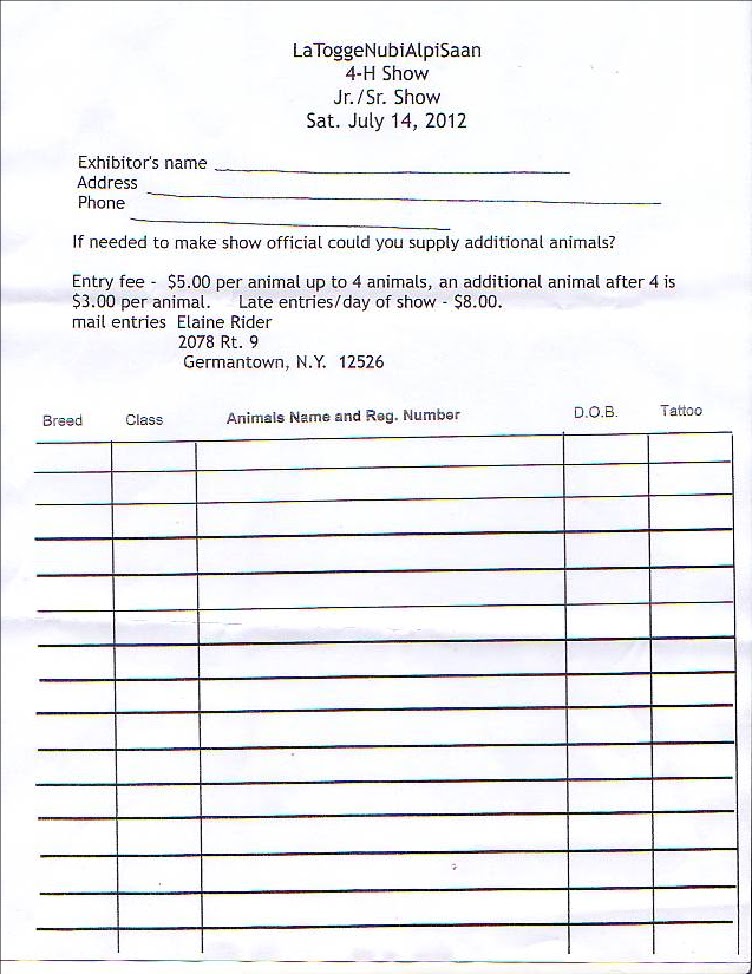
Youth Show Entry Form

Here is the entry form for the Dutchess County Youth Goat Show. If you want more information, please e-mail me at reynoldsgoats@yahoo.com

Reynolds' Acres Ranch Goat Registrations

Visit Reynolds' Acres Ranch Website!